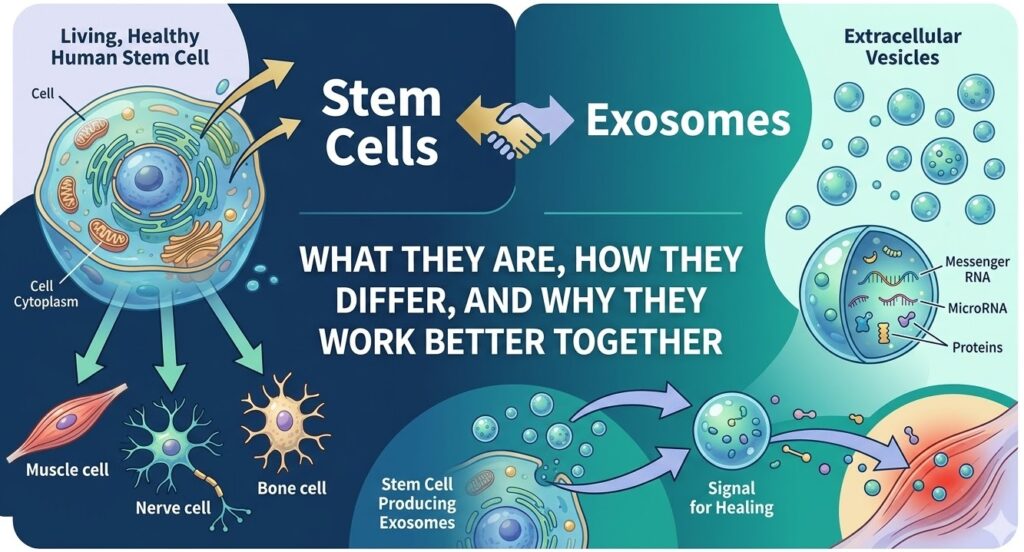
If you have been researching regenerative medicine, you have probably come across two terms more than any others: stem cells and exosomes. For a lot of people, these words get used interchangeably, or they get confused with each other entirely. That makes sense, because they are closely related. But they are not the same thing, and understanding the difference matters a lot if you are trying to make informed decisions about your health or a loved one’s care.
The good news is that you do not need a medical degree to understand what these two therapies are, how they work, and how they compare. This article breaks it all down in plain language. By the time you finish reading, you will have a solid grasp of what stem cells and exosomes each do, where they overlap, and why many clinicians are now combining the two in treatment protocols rather than choosing between them.
What Are Stem Cells?
Stem cells are living cells with a special ability that most cells in the body do not have: they can develop into many different types of cells. A muscle cell is always going to be a muscle cell. A liver cell is always going to be a liver cell. But a stem cell can, under the right conditions, transform into a variety of specialized cells depending on what the body needs. This ability is called differentiation, and it is what makes stem cells so valuable from a medical standpoint.
There are a few different types of stem cells that come up in clinical settings. Embryonic stem cells come from early-stage embryos and can become almost any cell type in the body. Induced pluripotent stem cells, or iPSCs, are adult cells that have been reprogrammed in a lab to behave similarly to embryonic stem cells. And then there are adult stem cells, which are found in various tissues throughout the body and are more limited in what they can become, but still highly useful therapeutically.
The type most commonly used in regenerative medicine clinics today is the mesenchymal stem cell, or MSC. These are found in bone marrow, fat tissue, umbilical cord tissue, and other sources. They have several properties that make them well-suited for treatment: they can reduce inflammation, they can support tissue repair, and they can communicate with surrounding cells to help coordinate the healing process.
That last point is especially important, and it leads directly to the topic of exosomes. When stem cells work their therapeutic magic, a significant portion of what they are actually doing is secreting molecules that signal other cells to act. One of the key vehicles for those signals is exosomes.
What Are Exosomes?
Exosomes are not cells. That is the first and most important thing to understand about them. They are tiny, bubble-like particles that cells release into the surrounding environment. Technically, they fall into a category called extracellular vesicles, and they are extremely small, ranging from about 30 to 150 nanometers in diameter. To give you some sense of scale, a single human hair is roughly 80,000 nanometers wide.
Despite their size, exosomes carry a surprising amount of biological cargo. Inside them you can find messenger RNA, microRNA, proteins, growth factors, and lipids. These molecules act as chemical messages that travel from one cell to another, delivering instructions. This is how cells communicate across distances in the body, and it turns out this system plays a massive role in how tissue is repaired and how the immune system is regulated.
Exosomes were discovered decades ago but were largely ignored for a long time because scientists thought they were just a way for cells to dispose of waste. In the last fifteen or so years, researchers began to realize that exosomes are actually sophisticated communication tools. That shift in understanding opened up a whole new area of research and, eventually, clinical application.
The exosomes that are most relevant to regenerative medicine are those derived from mesenchymal stem cells. MSC-derived exosomes carry much of the same healing information as the stem cells themselves, but without being living cells. That distinction creates some meaningful practical differences, which we will get into next.
Key Differences Between Stem Cells and Exosomes
Now that you have a working definition of each, it helps to look at how they compare across several categories.
What They Are
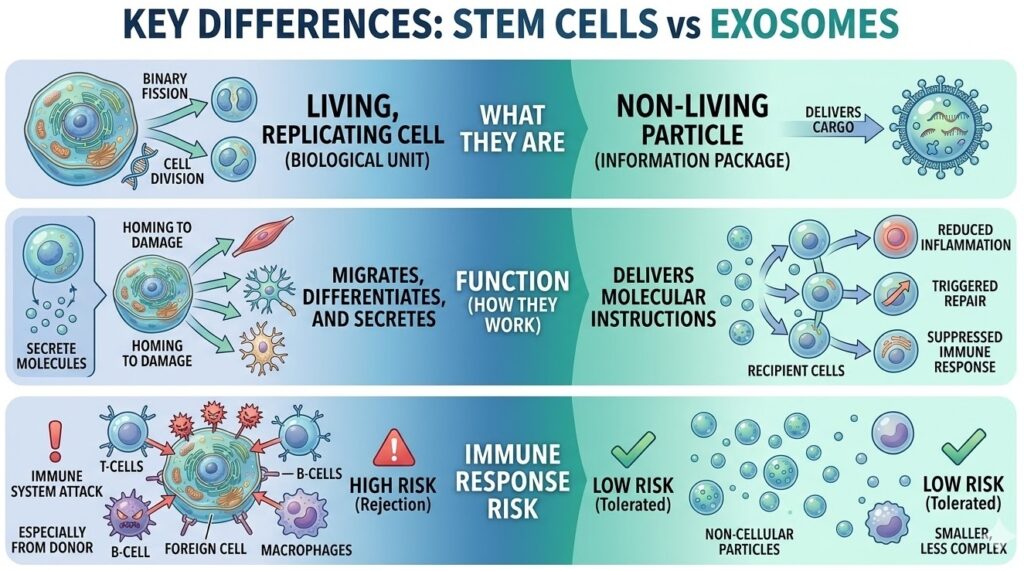
Stem cells are living, biological cells capable of replication and differentiation. Exosomes are non-living particles that cannot replicate on their own. They are more like packages of information than active agents.
How They Work
Stem cells can migrate to damaged areas in the body, a process called homing, and then differentiate into the type of cell that is needed. They also secrete healing molecules, including exosomes, as part of their activity. Exosomes, by contrast, work purely through signaling. They deliver molecular instructions to recipient cells and can influence how those cells behave, whether that means reducing inflammation, triggering repair processes, or suppressing an overactive immune response.
Immune Response Risk
One area where exosomes have a clear practical advantage is immune response. Because stem cells are living cells, there is always some risk of the immune system identifying them as foreign and mounting a reaction. This is especially true when the stem cells come from a donor rather than the patient. Exosomes, being non-cellular, present a significantly lower immune risk. They are smaller, less complex, and the body generally tolerates them well.
Storage and Handling
Stem cells require careful handling and have a relatively short window in which they remain viable. Exosomes are more stable and can be stored for longer periods under the right conditions, which makes logistics simpler and potentially reduces costs in a clinical setting.
How They Are Given
Both therapies can be administered intravenously, but exosomes are also being explored through inhalation, topical application, and direct injection into specific tissues. Stem cells are generally given through intravenous infusion or direct injection, and some applications require surgical delivery.
Regulatory Status
Stem cell therapies have a longer track record in clinical research, and while regulation varies by country, there is more precedent for their use. Exosomes are still an emerging area. In the United States, for example, exosomes are not yet approved as standalone drugs by the FDA, though research is ongoing and they are used in clinical settings in various countries under specific regulatory frameworks. Colombia has its own regulatory structure for regenerative medicine, and it is important for patients to work with clinics that operate within those guidelines.
Why Exosomes vs Stem Cells Is the Wrong Question
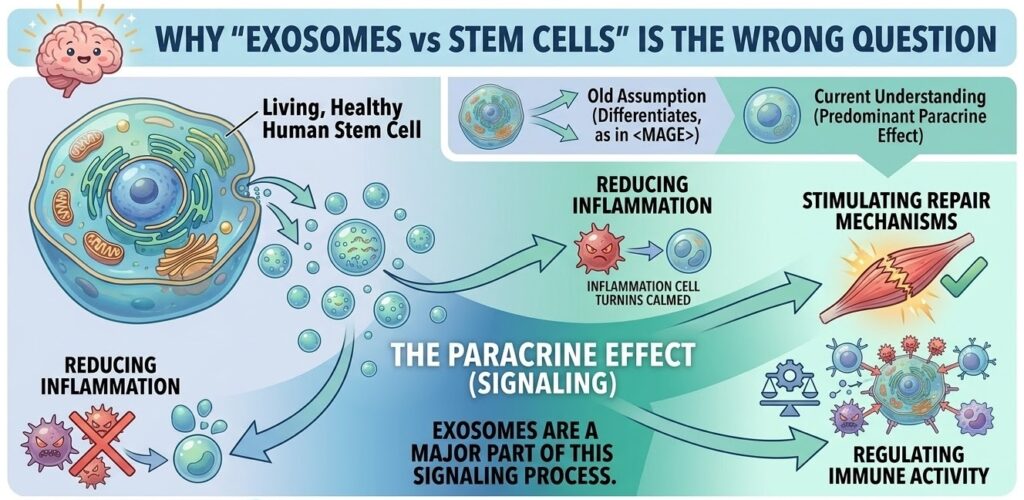
Here is something that often surprises people when they first learn about this topic: exosomes are produced by stem cells. They are not two separate systems competing for the same job. Exosomes are one of the main tools that stem cells use to do their work.
For years, researchers assumed that stem cells healed tissue primarily by differentiating into new cells and physically replacing what was damaged. That still happens, but studies over the last decade have made it increasingly clear that a huge portion of stem cell therapy’s benefit comes from what is called the paracrine effect. This means the stem cells are releasing signaling molecules into their environment, and those molecules are doing the heavy lifting in terms of reducing inflammation, stimulating the body’s own repair mechanisms, and regulating immune activity. Exosomes are a major part of that signaling process.
So when you ask whether to use stem cells or exosomes, you are in some ways asking whether to use a factory or the products the factory makes. Both have value, but they work differently, and they work best when considered as part of a coordinated strategy.
Combined treatment approaches are gaining attention in clinical research for exactly this reason. One approach involves administering exosomes alongside a stem cell protocol to amplify the signaling environment. Another uses exosomes to prime or activate the patient’s own existing stem cells, essentially giving the body a boost that helps its natural regenerative capacity kick in more effectively. Exosomes are also being explored as a maintenance or booster therapy following an initial stem cell treatment, helping to extend the therapeutic effect over time.
These combined approaches are showing particular promise in areas like neurological conditions, orthopedic injuries, and autoimmune diseases, where the complexity of the disease process benefits from multiple complementary mechanisms working at once.
Which Therapy Makes Sense for Which Patient
Because every patient is different and every condition presents differently, there is no single answer to this question. But there are some general patterns that tend to guide clinical thinking.
Stem cell therapy tends to be more appropriate when a condition requires active tissue regeneration, particularly in cases where the body needs new cells to replace those that have been lost or severely damaged. Patients who are in good overall health and are good candidates for more intensive protocols may benefit most from a full stem cell approach.
Exosome therapy may be preferred for patients who are looking for a lower-risk, non-cellular option, or for those who have already completed a stem cell protocol and want to support or extend their results. Conditions that are primarily driven by inflammation or immune dysregulation are also well-suited to exosome-focused treatment, given the strong anti-inflammatory and immunomodulatory signals that MSC-derived exosomes carry.
For many patients, a combined protocol is where the most benefit lies. The stem cells handle the structural and cellular aspects of repair, while exosomes reinforce and extend the signaling environment that makes that repair possible. A qualified clinician will evaluate your specific situation, your health history, and your treatment goals before recommending a path forward.
If you are exploring treatment options in Colombia, the consultation process typically involves a thorough review of your medical records, diagnostic testing, and a conversation about which therapies align with your needs. Reputable clinics will always start with this kind of individualized assessment rather than recommending a one-size-fits-all approach.

Safety and the Regulatory Environment
Both stem cell therapy and exosome therapy have generally favorable safety profiles when administered by qualified medical professionals using properly sourced and tested materials. That said, neither therapy is entirely without risk, and the quality of the provider matters enormously.
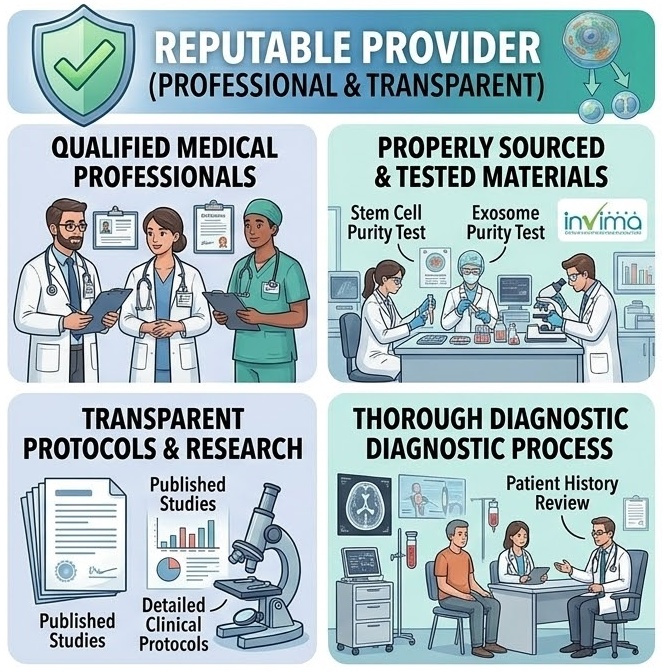
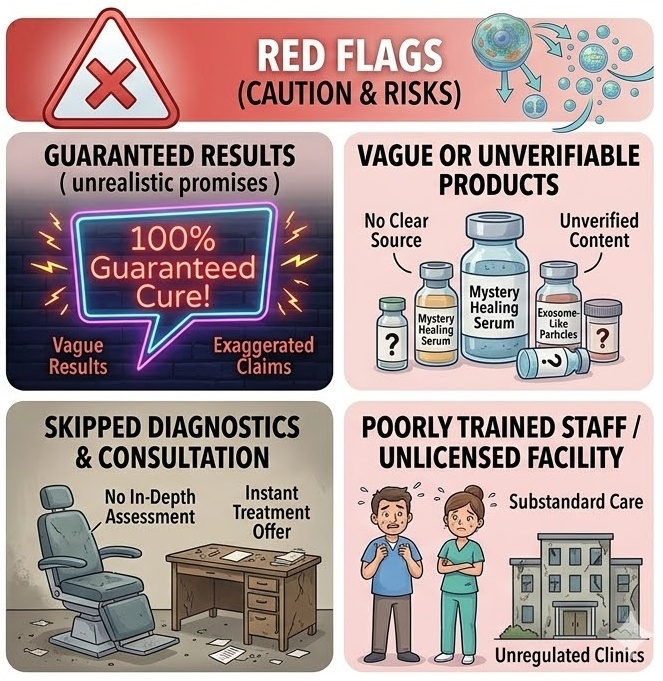
Red flags to watch for include clinics that promise guaranteed results, that use vague or unverifiable descriptions of their products, or that skip the diagnostic and consultation process entirely. A reputable provider will be transparent about the source of their stem cells or exosomes, the protocols they follow, and the research that supports their approach.
In Colombia, regenerative medicine is regulated through INVIMA, the national health regulatory authority. Clinics operating legally within this framework are required to meet specific standards for the sourcing, processing, and administration of biological therapies. Patients should always confirm that a clinic is operating within these regulatory guidelines before beginning any treatment.
On a global level, the regulatory picture for exosomes in particular is still evolving. Because they are not cells, they fall into a different category than traditional stem cell products, and agencies around the world are working to develop clear frameworks for their oversight. This does not mean exosome therapy is unsafe or illegitimate, but it does mean patients should do their homework and seek out providers who are rigorous about their sourcing and protocols.
Frequently Asked Questions
Are exosomes better than stem cells?
Neither is universally better than the other. They work through different mechanisms and are suited to different situations. In many cases, combining the two produces better results than using either alone. The right choice depends on your specific condition, your health status, and your treatment goals.
Can I receive both therapies at the same time?
In many cases, yes. Combined protocols that pair stem cell infusions with exosome therapy are being used clinically and are an active area of research. Your doctor will determine whether a combined approach makes sense for your particular situation.
How long do the effects last?
This varies considerably from patient to patient and depends on the condition being treated, the protocol used, and individual biology. Some patients report benefits lasting months or years. Booster treatments using exosomes are one strategy that some clinics use to help maintain and extend initial results.
Are these therapies covered by insurance?
In most cases, regenerative medicine therapies like stem cell treatment and exosome therapy are not covered by standard health insurance plans. This is partly because many applications are still considered experimental or investigational. It is worth checking with your provider and insurance company for specifics, but most patients pay out of pocket.
What should I ask my doctor before pursuing treatment?
Some important questions to raise include: What is the source of the stem cells or exosomes being used? What testing is done on the product before it is administered? What results should I realistically expect, and over what timeframe? What are the potential risks or side effects? Is this clinic operating within Colombia’s regulatory framework for biological therapies?
Bringing It All Together
Stem cells and exosomes are not rivals. They are part of the same biological system, and understanding how they relate to each other is the key to understanding why regenerative medicine has so much potential. Stem cells are remarkable in their ability to differentiate and regenerate tissue. Exosomes are remarkable in their ability to communicate, to signal, and to coordinate the body’s own healing processes. Together, they represent a more complete picture of how biological repair actually works.
The future of regenerative medicine is almost certainly going to involve smarter, more targeted use of both therapies, with protocols tailored to the individual rather than applied broadly. Research in this area is moving quickly, and Colombia is home to clinics at the forefront of making these therapies accessible within a medically responsible framework.
If you are curious about whether stem cell therapy, exosome therapy, or a combination approach might be right for your situation, the best next step is a consultation with a qualified specialist. At Stem Cells Colombia, we work with patients to build individualized treatment plans based on their specific needs, goals, and medical history. Reach out through stemcellscolombia.net to schedule a consultation and find out what options may be available to you.