Language Barriers: Communicating with Spanish-speaking Doctors
Traveling abroad for medical treatments is an exciting step toward better health, but it often brings up a very specific fear. You might wonder how you will accurately describe your symptoms, understand a procedure, or follow post-care instructions if you do not speak the local language. Medical tourism requires trust, and trust is built on clear communication.
While the primary language in Colombia is Spanish, a language difference does not have to be a roadblock to your healing. With the right preparation, helpful tools, and the support systems provided by modern medical facilities, you can navigate your medical journey with confidence.
The Reality of Top-Tier Colombian Healthcare
If you are traveling for advanced therapies, you will likely be treated by highly trained specialists. Many medical professionals in the country have completed part of their education or medical fellowships in the United States or Europe. Because of this international training, they frequently possess an advanced level of English.
When researching Colombian stem cells, patients are often relieved to find that premier clinics cater specifically to international travelers. These facilities usually have dedicated English-speaking patient coordinators and support staff. In fact, many doctors in the Medellin area are bilingual in English such as Aurora in Llanogrande. This means that from your initial consultation to your final follow-up, you will have professionals who understand your needs and can answer your questions in your native language.
Cultural Nuances: What to Expect from Colombian Doctors
Healthcare in Colombia is characterized by a cultural concept known as calidez, which translates to warmth. Doctors here are known for an empathetic, personal approach to medicine. You will likely find that consultations feel unhurried compared to the fast-paced nature of Western clinic visits.
This warmth translates directly into how they communicate with patients. A great deal of medical care is conveyed through active listening, reassuring body language, and a genuine desire to see you improve. Even if a physician is not perfectly fluent in English, their bedside manner often bridges the communication gap. It is also customary to address physicians formally as Doctor or Doctora. This simple sign of respect establishes a warm and positive dynamic right from the start.
Practical Tools and Strategies for Seamless Communication
Even with bilingual staff, it is wise to arrive prepared. Taking a few proactive steps will help ensure nothing gets lost in translation.
Medical Interpreters and Facilitators
Working with a medical concierge or a professional interpreter is one of the best ways to guarantee clarity. Premium clinics provide bilingual facilitators who accompany you during your appointments. They understand medical terminology in both languages and act as your personal advocate during complex conversations.
Leverage Technology
Translation applications have advanced significantly over the last few years. Apps like Google Translate or Microsoft Translator feature real-time conversation modes that allow two people to speak into a phone and hear the translated audio instantly. It is highly recommended to download the Spanish language pack on your device before you travel. This ensures your app works perfectly even if you temporarily lose Wi-Fi or cellular service while at a clinic.
Written Communication
Prepare your medical history, current medication list, and a list of your questions in advance. You can use online tools to translate these documents into Spanish before you leave home. Handing a translated, written copy of your medical background to your physician leaves no room for confusion regarding your previous treatments or allergies.
The Teach-Back Method
When receiving instructions about your aftercare or medication dosages, utilize the teach-back method. Simply repeat the instructions back to the doctor in your own words, using an interpreter or translation app. This confirms that you have completely understood the required protocol before you leave the building.
A Quick-Start Medical Spanish Glossary for Patients
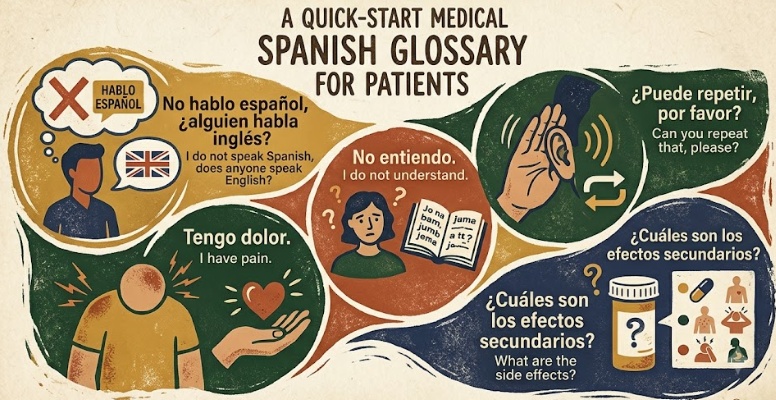
Having a few essential phrases committed to memory or saved on your phone can provide immense peace of mind. Here are some fundamental phrases you might find useful during your trip.
- I do not speak Spanish, does anyone speak English? (No hablo español, ¿alguien habla inglés?)
- I have pain. (Tengo dolor.)
- I do not understand. (No entiendo.)
- Can you repeat that, please? (¿Puede repetir, por favor?)
- What are the side effects? (¿Cuáles son los efectos secundarios?)
Patient Advocacy: Never Be Afraid to Pause
Informed consent is a universal standard in medicine. You have an absolute right to understand every single aspect of your treatment. If a conversation is moving too quickly, you should never feel pressured to nod along just to be polite. Simply ask the staff to pause and explain the concept again.
Visual aids can also be incredibly helpful. Ask your medical team to draw diagrams or use anatomical models to demonstrate where treatments will be administered and how they function in the body. Most professionals are more than happy to use visual tools to ensure you feel completely comfortable with the planned procedure.
Conclusion
A difference in spoken language is just a logistical detail. It should not stop you from accessing cutting-edge therapies and world-class care. Compassion, respect, and the drive to heal are universal. By relying on bilingual professionals, utilizing modern technology, and maintaining an open line of communication, your medical journey can be a smooth and highly positive experience.
If you are ready to explore your medical options but still have questions about the logistics of traveling for care, reach out to our team at Stem Cells Colombia. Contact our English-speaking coordinators today for a free consultation. We are here to guide you through every step of the process.