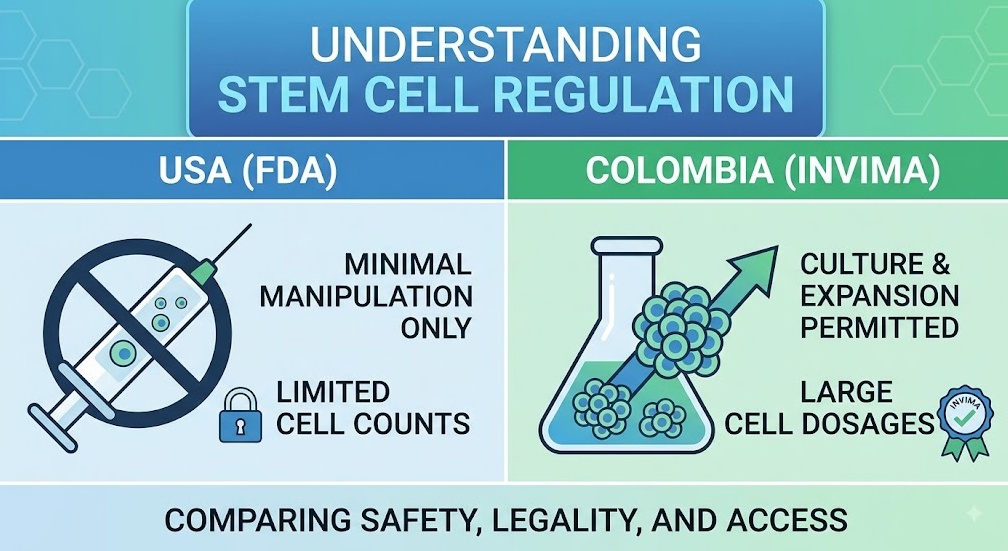
Patients researching international medical treatments face a steep learning curve, particularly when comparing the laws that govern biological medicines across different borders. In the United States, patients seeking regenerative treatments often find that their options are strictly limited by federal guidelines. These limitations prompt many individuals to look overseas for alternative options. For those looking into stem cell therapy in Colombia, a primary question quickly emerges regarding why certain cellular procedures are legally performed in South America but remain heavily restricted back home. The answer lies in the fundamental differences between how two major regulatory bodies interpret the safety, classification, and administration of human cells.
By comparing the United States Food and Drug Administration with Colombia’s National Food and Drug Surveillance Institute, known as INVIMA, patients can better understand the legal framework that makes international treatment possible. This knowledge is essential for making informed decisions and prioritizing safety when selecting a medical provider abroad.
The Regulatory Divide: How the FDA and INVIMA Differ
To understand the difference in medical offerings between the two countries, one must first look at how each government classifies human tissue. The divergence comes down to a concept known as cellular expansion, which is the laboratory process of multiplying cells before they are administered to a patient.
The United States Legal Framework
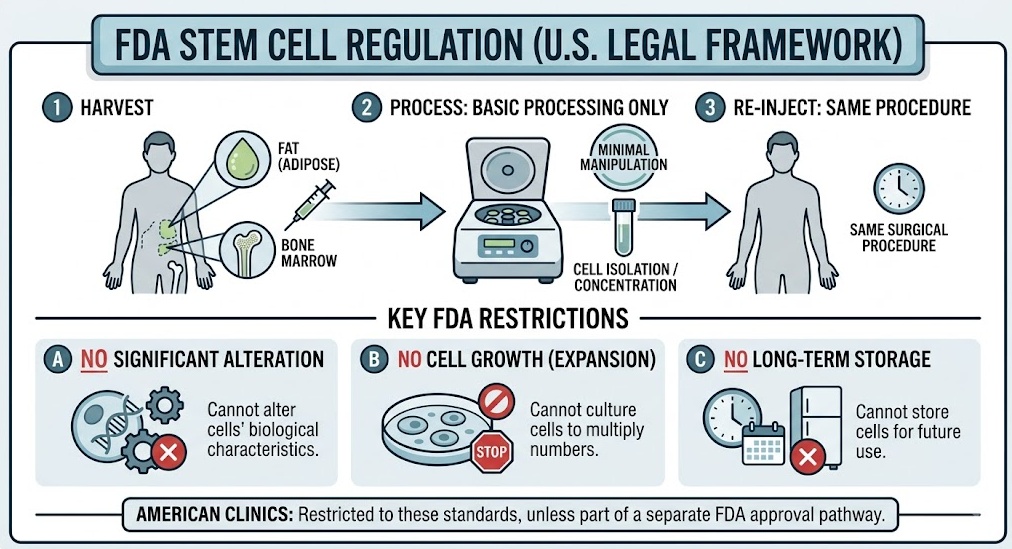
The FDA regulates stem cells under a specific set of rules covering Human Cells, Tissues, and Cellular and Tissue-Based Products. Under these guidelines, American clinics are generally restricted to a standard known as minimal manipulation. This means a doctor can harvest bone marrow or fat from a patient, spin it in a centrifuge to isolate the cells, and reinject it during the exact same surgical procedure. The cells cannot be significantly altered, grown, or stored for long periods.
If a laboratory attempts to culture and multiply those cells over several days, the FDA legally reclassifies the resulting product as an unapproved biological drug. Bringing a new biological drug to market in the United States requires extensive, multi-phase clinical trials that can cost hundreds of millions of dollars and take over a decade to complete. Consequently, the culturing of stem cells remains largely illegal outside of highly controlled and specific FDA-approved clinical trials.
The Colombian Legal Framework
Colombia approaches the same scientific process from a different regulatory philosophy. The country’s primary regulatory agency, INVIMA, treats the culturing and expansion of cells as an advanced medical procedure rather than the mass manufacturing of a pharmaceutical drug.
INVIMA has established a regulated access model. Instead of enacting a blanket restriction on cellular expansion, the Colombian government permits the practice provided it occurs within highly regulated, specially licensed laboratories. These laboratories must meet rigorous international standards for cleanliness and safety. By regulating the laboratories and the physicians rather than classifying the cells themselves as commercial drugs, Colombia allows patients to access expanded cellular treatments legally and safely under direct government oversight.
The Science and Necessity of Cell Expansion
Understanding the legal differences leads naturally to questioning why a patient would need expanded cells in the first place. The restrictions in the United States mean patients only receive the number of cells their body naturally produces in the small sample taken during their procedure. For many medical conditions, that baseline number is simply not enough to trigger a significant healing response.
Why Culturing Matters
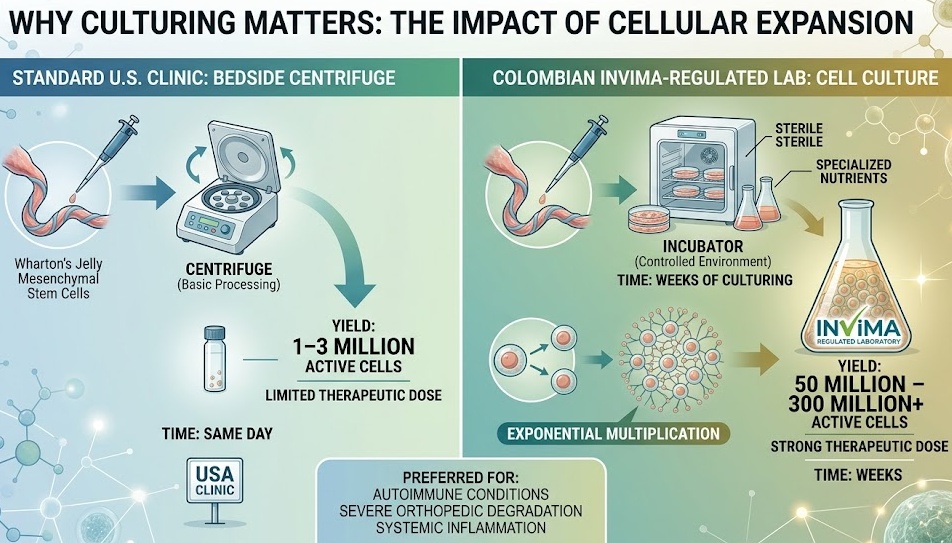
Cellular expansion is the process of taking a small starting sample of tissue and placing it in an incubator with specialized nutrients. Over the course of several weeks, the cells multiply exponentially. This is particularly relevant when working with mesenchymal stem cells derived from Wharton’s Jelly, which is the gelatinous tissue found inside an umbilical cord.
A standard bedside centrifuge procedure in a United States clinic might yield a few million active stem cells. In contrast, an INVIMA-regulated laboratory in Colombia can culture a tissue sample until it yields anywhere from 50 million to over 300 million active cells. Doctors working with autoimmune conditions, severe orthopedic degradation, or systemic inflammation generally prefer these massive cell counts because they provide a much stronger therapeutic dose to the patient.
Tissue Sourcing Rules
Colombia’s regulations also strictly govern where these starting tissues originate. While some treatments use a patient’s own tissue, many advanced protocols utilize allogeneic sources, meaning the tissue comes from a donor.
Under INVIMA guidelines, umbilical cords can only be collected from healthy mothers who have undergone extensive medical screening and have delivered full-term babies via scheduled cesarean sections. The tissue is ethically donated following the birth, meaning no harm comes to the mother or the child. The rigorous screening process ensures the donor material is completely free of genetic abnormalities and communicable diseases before it ever enters the laboratory for expansion.
Good Manufacturing Practice and Laboratory Benchmarks
The core of Colombia’s regulatory success relies on enforcing strict laboratory environments. Expanding cells safely requires a flawless sterile environment to prevent contamination. INVIMA enforces Good Manufacturing Practice standards to ensure every batch of cells is safe for human use.
Facility Standards and Cleanrooms
Culturing stem cells cannot happen in a standard doctor’s office or a traditional hospital room. INVIMA requires laboratories to operate certified ISO Class 7 cleanrooms. These specialized environments utilize advanced High Efficiency Particulate Air filtration systems that cycle and scrub the air dozens of times per hour. The strict airflow regulations prevent microscopic dust, bacteria, and fungal spores from contaminating the cell cultures. Laboratory technicians must wear full sterile suits, and all equipment is subjected to intense sterilization protocols before and after every single use.
Cell Viability and Quality Control
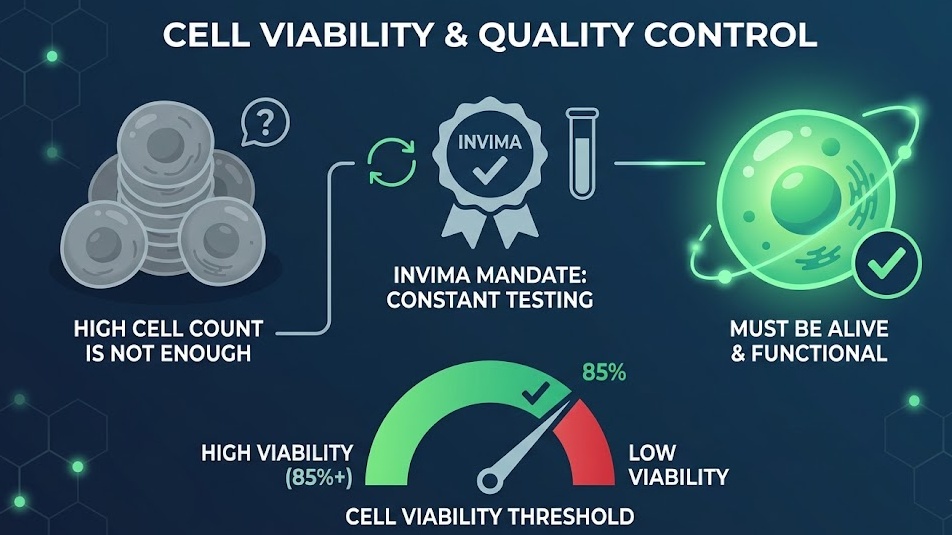
Generating a high number of cells is only half the battle. The cells must actually be alive and capable of functioning once they enter the patient’s body. INVIMA regulations require laboratories to test the viability of their cell batches constantly.
A high-quality laboratory will maintain a minimum cell viability threshold of 85 to 95 percent. If a batch drops below these strict viability metrics, the laboratory must destroy the cells. Administering dead or dying cells provides zero therapeutic benefit to the patient, so enforcing these high viability thresholds is a crucial component of consumer protection and medical efficacy.
Pathogen Screening and Sterility Testing
Before any expanded cells leave the laboratory for administration, they undergo a final round of intense safety testing. Even though the donor mother was screened prior to the birth, the final cultured product is tested again for diseases like HIV, Hepatitis B, Hepatitis C, and Syphilis. Furthermore, the batches are tested for endotoxins and mycoplasma, which are microscopic bacterial contaminants that could cause severe infections if injected into a patient. Only after a batch passes all of these sterility tests is it cleared for medical use.
Patient Verification Checklist and Identifying Red Flags
While Colombia offers a legally sound framework for these treatments, patients must still practice due diligence. As with any booming medical industry, the quality of care can vary between clinics. Patients must know how to verify that a clinic is operating legally within the INVIMA framework.
Verifying Clinic Credentials
Prospective patients should never hesitate to ask a clinic for its official licensing documentation. A reputable clinic will readily provide its INVIMA registration numbers and the licensing information for its partner laboratory. Patients can take these registration numbers and cross-reference them directly with Colombian health authorities to ensure the facility is currently in good standing and authorized to handle cellular products.
The Certificate of Analysis
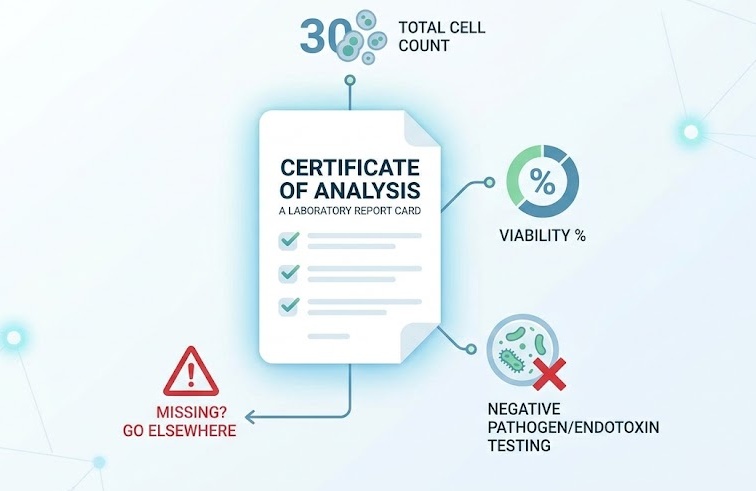
The most important document a patient can request is the Certificate of Analysis. This document is essentially a laboratory report card for the specific batch of cells the patient is going to receive. A proper Certificate of Analysis will display the total cell count, the exact viability percentage, and the negative results for all pathogen and endotoxin testing. If a clinic cannot or will not provide a Certificate of Analysis from a certified laboratory, the patient should immediately seek treatment elsewhere.
Recognizing the Warning Signs
Patients should be wary of facilities that operate outside the bounds of traditional medical ethics. The most glaring warning sign is a clinic that promises an absolute cure for an incurable disease. Regenerative medicine is a powerful tool for managing symptoms and promoting healing, but it is not magic. Unregulated operators often use high-pressure sales tactics and guarantee unrealistic medical outcomes. Legitimate clinics focus on realistic expectations, transparent data, and thorough patient evaluations.
Medical Traceability and Aftercare Standards
A well-regulated medical system does not stop caring for the patient once the procedure is over. The Colombian legal framework mandates specific tracking and follow-up procedures to ensure long-term safety.
Medical traceability is a primary requirement for INVIMA compliance. Laboratories must maintain a strict chain of custody for every cell batch. This means the government can trace a single syringe of stem cells back to the specific laboratory technician who cultured it, the exact date it was processed, and the original donor who provided the umbilical cord. This level of traceability is identical to the standards used in international blood banks and organ transplant centers.
Furthermore, clinics are legally required to monitor patients for adverse events immediately following the procedure. Reputable facilities also establish long-term communication with their international patients, coordinating with the patient’s primary care physicians back home. This ensures that the patient’s recovery is tracked and supported long after they have boarded their flight and left Colombia. By adhering to these strict regulatory frameworks, laboratory standards, and ethical medical practices, Colombia has established itself as a highly capable environment for advanced regenerative therapies.